
A lookalike audience is an advertising targeting method that uses algorithms to find new prospects who share key characteristics with your existing best customers. Instead of manually defining demographic and interest filters, you let the platform's algorithm do the work — using your first-party customer data as the blueprint.
If reducing cost per acquisition and improving lead quality are part of your paid advertising goals, lookalike audiences are one of the most effective tools available to modern marketers. This guide explains what lookalike audiences are, how platforms build them, the key benefits, and best practices — including how to use Ortto to create and sync the high-quality source audiences that make lookalike targeting work.
Key stat: Lookalike audiences can reduce cost per acquisition by up to 73% compared to interest-based targeting, according to Meta's internal data.
What is a lookalike audience?
(Facebook and Instagram), Google, LinkedIn, TikTok, and others. Rather than building an audience from demographic or interest filters, lookalike targeting uses a machine learning algorithm to identify people who resemble your existing customers or high-value segments.
On most platforms, you can create a lookalike audience based on:
A custom audience uploaded via CSV or automatically synced via a customer data platform (CDP) like Ortto
Conversion pixels you have created in the advertising platform
People who follow or engage with your business page
Within each source type, you can adjust the audience size — controlling how closely the lookalike mirrors your source. A tighter match means a smaller, higher-quality audience; a broader match gives more reach at the cost of some similarity.
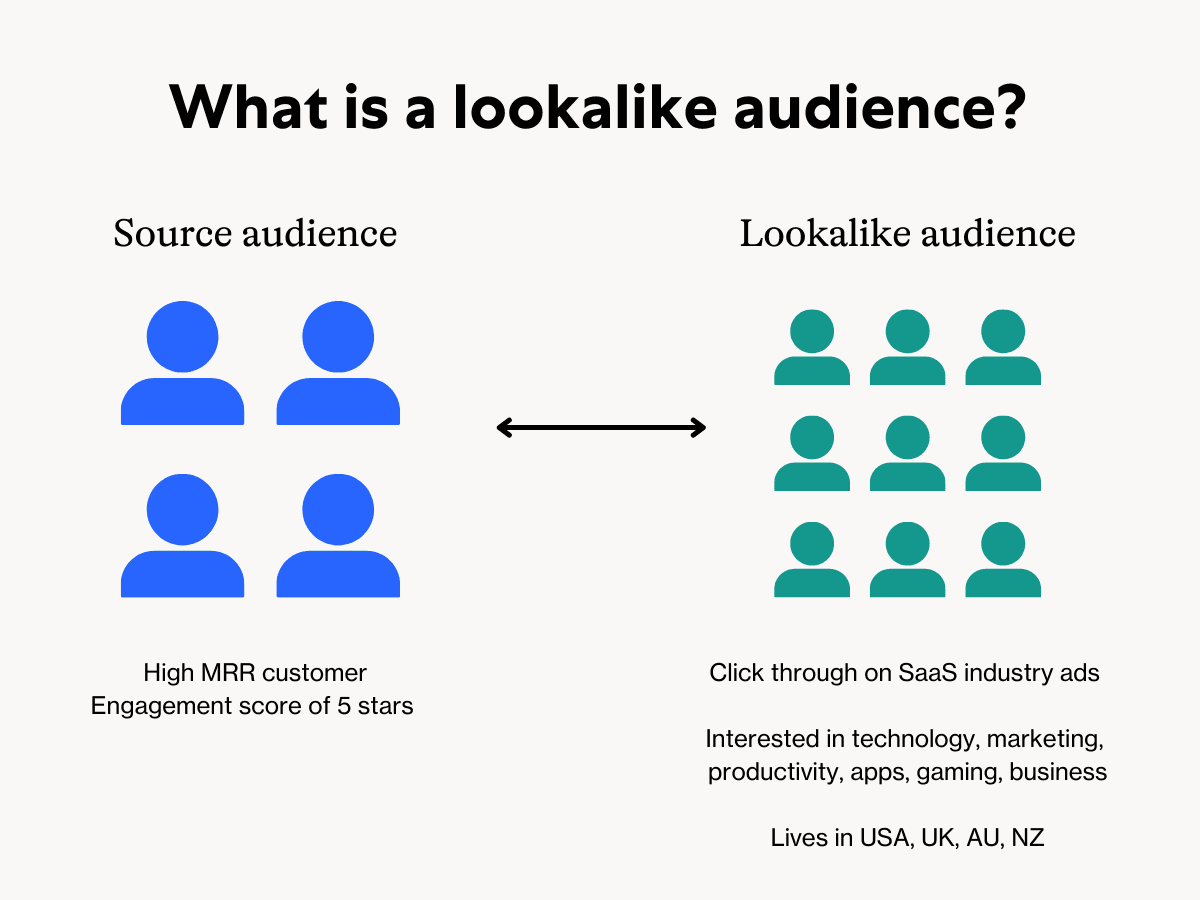
The quality of your lookalike audience is only ever as good as the source data you feed it. This is where Ortto's CDP plays a critical role — allowing you to build precise, behaviorally-filtered segments and sync them directly with your ad platforms in real time.
How do ad platforms build their lookalike audience?
Most platforms keep their exact algorithms proprietary, but the general process is well understood. When you provide a source audience, the platform analyses the shared characteristics of those people and uses that pattern to find similar users in its broader population. The data signals typically include:
Purchasing habits and transaction history
Content interactions: likes, comments, shares, and saves
Declared interests and profile data (age, location, job title)
Page likes and follows
Ads clicked and engagement history
Pixel events: page visits, add-to-cart, purchases
Activity in groups and communities
The algorithm uses this data to surface a net-new audience that matches the profile of your source. The more accurate and specific your source audience, the better the match — which is why using rich, first-party data from a CDP like Ortto produces better results than a generic email list.
Key stat: First-party data-based lookalike audiences outperform third-party interest targeting by 2–3x on return on ad spend, according to research by Nielsen.
Benefits of using lookalike audiences
Simplify your targeting
Ad platforms like Meta and Google offer hundreds of demographic and interest filters — which can quickly become overwhelming. Lookalike audiences remove the guesswork by letting the algorithm build the audience for you, based on patterns in your actual customer data rather than assumptions.
Save time
When your CDP is integrated directly with your ad platforms, you can sync live audience segments — like 'high-LTV customers' or 'active trial users' — without manually exporting and uploading CSVs. Ortto's native integrations with Meta, Google, and other ad platforms automate this entirely, keeping your lookalike source audiences fresh without manual effort.
Get higher quality leads
Interest-based targeting relies on assumptions about who your ideal customer might be. Lookalike audiences are grounded in fact — built from people who are already your customers. This means the algorithm surfaces prospects who are genuinely more likely to convert, reducing wasted ad spend and improving lead quality at the top of your funnel.
Inform more relevant ad creative
When your lookalike source is a specific, well-defined segment — such as your highest-retention SaaS customers or your top-spending eCommerce buyers — you have a clear picture of who you're speaking to. That makes it easier to select messaging, creative formats, and offers that are likely to resonate with the new audience you're targeting.
Best practices for lookalike audiences
1. Use the right source audience for your goal
The most common mistake in lookalike targeting is using a generic or low-quality source audience. A list of all email subscribers, for example, will include people at every stage of engagement — from loyal customers to people who signed up once and never returned.
Instead, filter your source to reflect your actual goal. If you want to acquire customers who stay long-term, use a segment of your highest-LTV customers. If you want more trial signups, use a segment of users who converted from trial within 14 days. Ortto's CDP makes this simple — apply behavioral and demographic filters to build a precise source segment, then sync it to your ad platform automatically.
2. Test your audience size on Meta
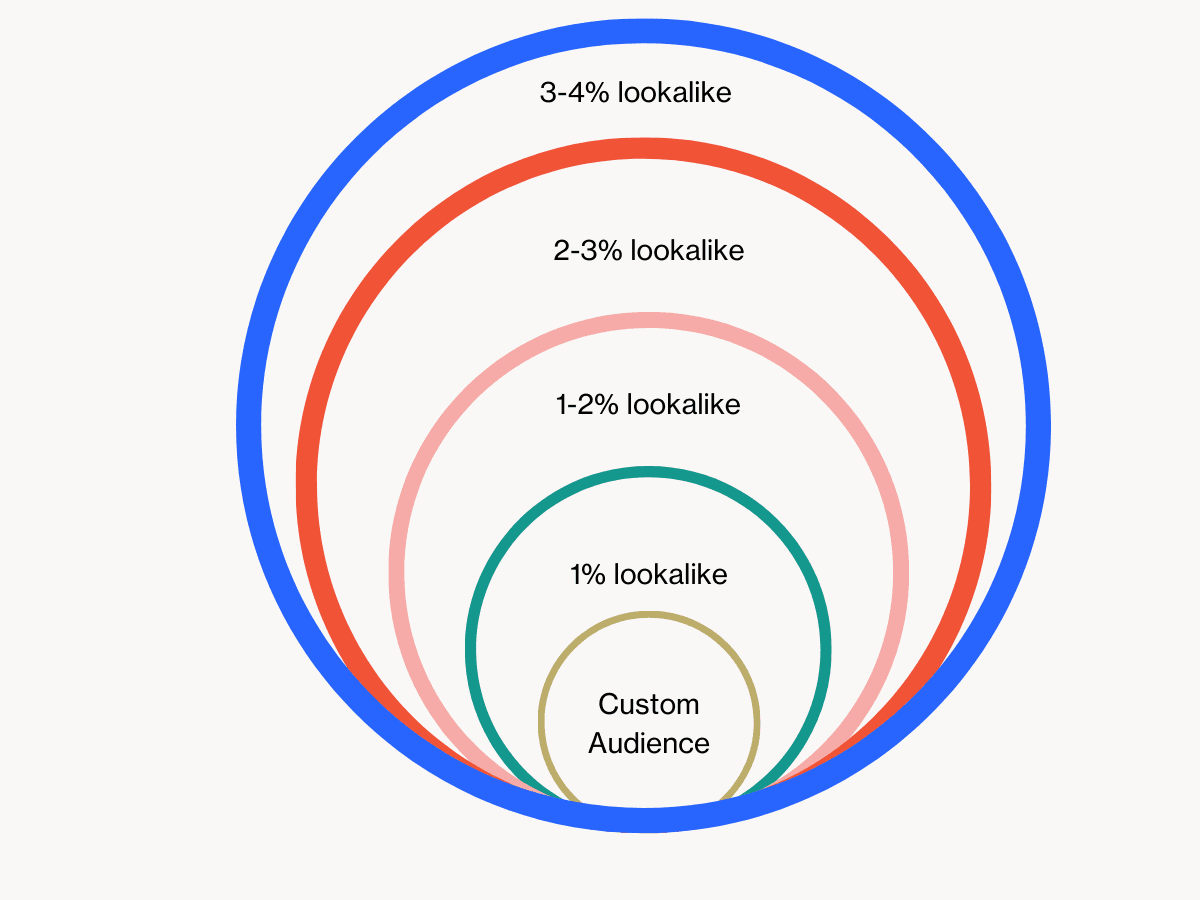
Meta's lookalike audience size is expressed as a percentage of the total addressable population in your target country. A 1% match is the most similar to your source audience — smaller, more expensive, and higher quality. A 10% match casts a much wider net with lower per-impression costs but less precision.
The right choice depends on your business type, budget, and campaign length:
B2B SaaS with a niche target market: Optimise for similarity — start with 1–2%.
B2C or eCommerce with a broad market: Optimise for reach — test 3–5% or higher.
Meta allows up to 500 lookalike audiences from a single source, so you can test a nesting strategy — creating a 1%, 3%, and 5% audience simultaneously, bidding higher on the tighter match. If you use this approach, always exclude the 1% audience from the 3% group to prevent audience duplication and conflicting messaging.
3. Keep your source audiences up to date
Lookalike audiences are typically refreshed by ad platforms every 3–7 days. But your source data needs to stay current for those refreshes to be meaningful. Ortto's dynamic audience sync ensures your source segments update automatically as customers enter or exit — so your lookalike audience always reflects your most recent, highest-quality customer data, without manual CSV uploads.
4. Monitor and exclude for audience overlap
If you are running multiple lookalike campaigns from different source audiences — say, one from high-LTV customers and another from newsletter subscribers — there is a strong likelihood of overlap. The same individuals appearing in multiple audiences can result in conflicting messaging or inflated frequency.
Use Meta Business Suite's audience overlap tool to check for duplication. In Ortto, you can also apply exclusion filters when building your segments — for example, 'Is a member of high-LTV audience' + 'Is not a newsletter subscriber' — to ensure clean, non-overlapping source data before syncing.
5. Pair lookalike audiences with strong landing page personalisation
Lookalike targeting gets the right people to your site — but conversion depends on what happens next. The most effective lookalike campaigns pair precise audience targeting with landing pages tailored to that segment. Use Ortto's analytics to understand how different audience segments behave on-site, and optimise your landing page messaging accordingly.
Ortto tip: Use Ortto's segmentation to build source audiences based on product usage events, not just demographics — for example, 'customers who triggered 5+ key actions in the last 30 days'. These behaviorally-defined segments consistently produce the strongest lookalike results.
How Ortto powers your lookalike audience strategy
Ortto's CDP is purpose-built to give marketers the clean, rich, real-time first-party data that lookalike targeting depends on. Here's how it fits into your workflow:
Build precise source segments using behavioral, demographic, and transactional filters in Ortto's audience builder.
Sync those segments automatically to Meta, Google, and other ad platforms via Ortto's native integrations — no CSV exports required.
Keep audiences fresh with dynamic syncing that adds and removes contacts in real time as they meet or exit your segment criteria.
Track the full customer journey from ad click to conversion inside Ortto, so you can measure true ROI and refine your source audiences over time.
→See Ortto's audience sync in action — Book a demo
Frequently asked questions
What is a lookalike audience?
A lookalike audience is an advertising targeting method that uses machine learning to find new prospects who share key characteristics with your existing customers. You provide a source audience — such as your best customers — and the ad platform builds a net-new audience of people with similar traits, interests, and behaviors.
How do lookalike audiences work?
Ad platforms analyse the shared characteristics of your source audience — including interests, demographics, purchasing habits, and online behavior — and use that pattern to identify similar people within their larger user base. The algorithm creates a new targetable audience based on this match, without you needing to manually define targeting criteria.
What platforms support lookalike audiences?
Meta (Facebook and Instagram) is the most widely used platform for lookalike audiences, but the feature is also available on Google (Similar Audiences), LinkedIn (Lookalike Audiences), TikTok, Snapchat, and Pinterest. Each platform uses its own algorithm and terminology, but the core concept is the same.
What makes a good lookalike source audience?
A strong source audience is specific, behaviorally filtered, and reflects your actual goal. Rather than using your entire contact list, use a filtered segment — such as your highest-LTV customers, most engaged trial users, or fastest-converting leads. The more precise your source, the more accurate the lookalike. Ortto's CDP makes it easy to build and automatically sync these segments.
What is the difference between a 1% and 10% lookalike audience on Meta?
The percentage refers to how closely the lookalike matches your source audience. A 1% lookalike is the most similar — a smaller, higher-quality pool that typically costs more to reach but converts better. A 10% lookalike is less precise but much larger, giving you greater reach at a lower cost per impression. Most advertisers test multiple sizes simultaneously using a nesting strategy.
How does Ortto help with lookalike audience targeting?
Ortto's CDP lets you build highly specific audience segments using behavioral, transactional, and demographic filters, then automatically sync those segments to your ad platforms in real time. This removes the need for manual CSV exports, keeps your source audiences current, and gives you a complete view of how each audience performs across the full customer journey.
Final word
Lookalike audiences are one of the most effective tools in a modern marketer's paid acquisition toolkit. They replace guesswork with data, reduce wasted ad spend, and consistently surface higher-quality leads — but only when the underlying source data is accurate, specific, and kept current.
That is where Ortto comes in. By connecting your CDP directly to your ad platforms, Ortto ensures your lookalike source audiences are always built from your best first-party data and synced automatically — so your campaigns are optimised from the moment they launch.