
An SMS sender ID is the name or number that appears as the sender when a recipient receives a text message from a business. It is the first thing a recipient sees — before they read a single word of your message — and it determines whether they open it, ignore it, or report it as spam.
For marketers investing in SMS as a channel, getting your sender ID right is foundational. The wrong choice — or no choice at all — can harm deliverability, erode trust, and waste your entire SMS budget. The right one reinforces your brand, boosts open rates, and keeps you compliant with carrier regulations in every region you send to.
This guide covers everything you need to know: the three sender ID types, how to choose the right one for your region and use case, and how Ortto's SMS marketing platform makes setup and compliance straightforward.
Key stat: SMS has an average open rate of 98%, compared to roughly 20% for email — but only registered, trusted sender IDs consistently reach that benchmark. (Twilio, 2025)
What is an SMS sender ID?
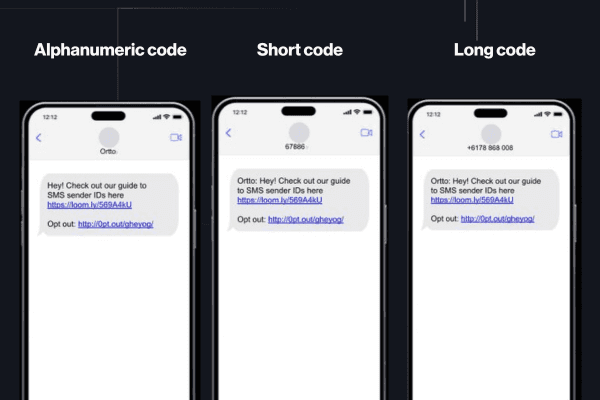
An SMS sender ID is a numeric or alphanumeric identifier that displays as the 'from' field when a business sends an SMS to a recipient. It replaces the raw phone number with something recognisable — either a brand name like 'Ortto', a short numeric code like '12345', or a standard long number like a regular mobile.
Sender IDs serve two purposes. First, they help recipients quickly identify the sender and decide whether to open the message — which directly impacts open rates and engagement. Second, when registered with carriers, they verify your identity as a legitimate sender, reducing the likelihood of your messages being flagged as spam or blocked entirely.
Without a sender ID, your messages arrive from an unrecognised number that recipients have no reason to trust — making this one of the most impactful and often overlooked elements of an SMS marketing setup.
Types of sender IDs
There are three main types of SMS sender IDs, each with different use cases, regional availability, and communication capabilities. Choosing the right type depends on where you're sending, how much volume you're sending, and whether you need two-way messaging.
Alphanumeric sender IDs
Character allowance: Up to 11 characters — a combination of upper and lower case letters, numbers, and spaces. Must include at least one letter.
Communication type: One-way only. Recipients cannot reply to messages sent from an alphanumeric ID.
Regional support: Supported in Australia, the UK, and most of Europe. Not supported in the US or New Zealand — senders in those regions must use a long code or shortcode.
Key note: Best for brands sending high-volume, one-way marketing messages where brand recognition is the priority. Your brand name is the ideal choice — for example, 'Ortto'.
Long codes and toll-free numbers
Character allowance: Up to 15 digits. In the US, this is typically a 10DLC (10-digit long code) or a standard toll-free number.
Communication type: Two-way. Recipients can reply, making this suitable for support, opt-in flows, and conversational messaging.
Regional support: The most widely supported sender ID type globally. Many countries, including Australia, require registration with a carrier to prove brand ownership — lodged through your SMS provider.
Key note: Registration approval is faster than shortcodes — typically 1–3 business days in most regions. 10DLCs in the US do not require a separate verification process for toll-free numbers.
Shortcodes
Character allowance: Typically 5–6 digits. In New Zealand, shortcodes are 3–4 digits.
Communication type: Two-way messaging is generally supported. Shared shortcodes are banned in the US and New Zealand.
Regional support: Compulsory for bulk SMS in New Zealand. Widely supported in the US and UK. Shared shortcodes are available in the UK but carry risks including accidental opt-outs.
Key note: Shortcodes have the longest carrier approval times: 8–12 weeks in the US, 10–12 weeks in the UK, and 5–6 weeks in New Zealand. Plan ahead if shortcodes are part of your strategy.
Ortto tip: Ortto's SMS marketing platform supports alphanumeric sender IDs, long codes, toll-free numbers, and shortcodes — with built-in compliance settings for each region. You can configure your sender ID directly in your Ortto SMS compliance settings.
What is an SMS brand prefix?
A brand prefix is a text label — typically your brand name — that appears at the very start of an SMS message body when you don't have a registered sender ID. For example: 'ORTTO: Your order has shipped.' The prefix acts as a substitute for a sender ID, but with a significant drawback: it counts toward your character limit.
A standard SMS is limited to 160 characters. A brand prefix like 'ORTTO: ' consumes 7 of those characters before your message even begins. For frequent or high-volume senders, this overhead adds up — either forcing shorter messages or pushing you into multi-part SMS that cost more per send.
Using a registered sender ID eliminates the need for a brand prefix entirely, freeing up your full character allowance for message content and reducing cost per SMS.
Benefits of using a dedicated SMS sender ID
Both long codes and shortcodes can be shared or dedicated depending on the country. A shared number is a lower-cost entry point and may be sufficient for low-volume or one-off campaigns. For businesses sending regularly or at scale, a dedicated sender ID is best practice — and the benefits compound over time.
Build brand recognition
Every SMS you send from a consistent, recognisable sender ID reinforces your brand in the recipient's mind. Whether it's your brand name (alphanumeric) or a number they've seen before (long code or shortcode), familiarity builds trust — and trust drives opens.
Increase open rates
Recipients are significantly more likely to open a message from a sender they recognise. A registered, trusted sender ID signals that the message is legitimate — reducing the hesitation that unrecognised numbers trigger. Given that SMS open rates average 98% when messages are delivered, protecting deliverability with a proper sender ID is essential to realising that potential.
Improve SMS deliverability
Carrier networks are increasingly sophisticated at filtering spam. Registered and authorised sender IDs are treated as verified senders, making them significantly less likely to be flagged or blocked. An unregistered number sending at volume, by contrast, is a common spam signal — and once flagged, remediation can be slow and costly.
Prevent brand impersonation
When your sender ID is registered, it becomes harder for bad actors to send fraudulent messages impersonating your brand. This protects your customers and your reputation — particularly important in industries like financial services and healthcare where SMS phishing is a known attack vector.
Eliminate the brand prefix overhead
As covered above, a dedicated sender ID removes the need for a brand prefix in your message body — recovering valuable character space and reducing your per-message cost at scale.
Key stat: Businesses using registered sender IDs see up to 25% higher SMS deliverability rates compared to unregistered numbers. (GSMA Mobile Economy Report, 2024)
How to choose your SMS sender ID
The right sender ID depends on three factors: the regions you're sending to, whether you need two-way messaging, and your sending volume. Here's how to think through each option:
Choose an alphanumeric ID if...
You are sending one-way marketing messages (promotions, announcements, alerts).
Your primary markets are Australia, the UK, or other countries that support alphanumeric IDs.
You want maximum brand recognition — use your brand name or the closest available variation.
You have a separate long code or shortcode for two-way communication and opt-in flows.
Note: If your audience is in the US or New Zealand, alphanumeric IDs are not supported — you'll need a long code or shortcode instead.
Choose a long code or toll-free number if...
You need two-way messaging — for support, conversational flows, or double opt-in confirmation.
You want the fastest approval timeline (typically 1–3 days in most markets).
You are sending to multiple countries and need the broadest global support.
You are a US sender — 10DLC is the standard for application-to-person (A2P) messaging in the US.
Choose a shortcode if...
You are sending bulk SMS campaigns in New Zealand, where shortcodes are compulsory.
You are a high-volume US or UK sender and want carrier approval to maximise deliverability.
You want a vanity code — numbers that correspond to your brand name (e.g. Ortto = 67886).
Important: Budget lead time for approval. Shortcode registration takes 8–12 weeks in the US, 10–12 weeks in the UK, and 5–6 weeks in New Zealand.
If you choose a dedicated shortcode or vanity code, research number availability across all target countries before committing — your desired code may already be taken in one of your key markets.
How Ortto supports your SMS sender ID setup
Ortto's SMS marketing platform is designed to make sender ID configuration and compliance straightforward, regardless of the regions you're sending to. Here's how it fits into your workflow:
Configure your sender ID directly in Ortto's SMS compliance settings — supporting alphanumeric IDs, long codes, toll-free numbers, and shortcodes.
Manage opt-ins and opt-outs automatically, with built-in compliance defaults for each region — including mandatory opt-out language and double opt-in flows where required.
Set a brand prefix as a fallback for any messages sent before your sender ID is approved — keeping your brand visible while registration is in progress.
Connect via Twilio or TallBob — Ortto's SMS provider integrations handle the technical setup of your sender ID registration, so you don't need to manage carrier relationships directly.
→ See Ortto's SMS marketing in action — Book a demo
Frequently asked questions
What is an SMS sender ID?
An SMS sender ID is the name or number that appears in the 'from' field when a business sends a text message. It can be alphanumeric (like a brand name), a long code (a standard mobile number), or a shortcode (a short 5–6 digit number). A registered sender ID helps recipients identify the sender, builds trust, and improves deliverability.
What are the three types of SMS sender IDs?
The three types are: alphanumeric sender IDs (up to 11 characters, one-way only, not supported in the US or New Zealand), long codes and toll-free numbers (up to 15 digits, two-way capable, broadly supported globally), and shortcodes (5–6 digits, two-way capable, required for bulk SMS in New Zealand).
What is the difference between a dedicated and shared sender ID?
A dedicated sender ID is exclusively yours — your brand name, your number, your identity. A shared sender ID is used by multiple businesses simultaneously. Shared IDs are cheaper but carry risks: accidental opt-outs (if another brand's subscriber replies to your number), inconsistent brand recognition, and reduced deliverability. Shared shortcodes are banned in the US and New Zealand. For any brand sending at volume or regularly, a dedicated sender ID is strongly recommended.
Do I need to register my SMS sender ID?
In most countries, yes. Registration is required to prove brand ownership, prevent impersonation, and ensure your messages are treated as legitimate by carrier networks. The registration process is handled through your SMS provider — for Ortto users, this is done via Twilio or TallBob. Unregistered numbers sending at volume are a common spam signal and risk being blocked.
How long does SMS sender ID approval take?
Approval timelines vary by type and region. Long codes and toll-free numbers are the fastest — typically 1–3 business days in most markets. Shortcodes take significantly longer: 8–12 weeks in the US, 10–12 weeks in the UK, and 5–6 weeks in New Zealand. Alphanumeric sender ID approval timelines vary by country but are generally faster than shortcodes.
Can I use the same shortcode across multiple countries?
You need to apply and pay for a shortcode separately in each country — and your preferred number may already be taken in one of your target markets. If consistency across markets is important to your brand, research availability in all target countries before committing to a specific code.
How do opt-ins and opt-outs work with alphanumeric sender IDs?
Because alphanumeric IDs are one-way, recipients cannot reply to opt out. You must provide a clear alternative opt-out method in every message — typically a URL that triggers an automatic opt-out, or a separate long code or shortcode that recipients can text to unsubscribe. Ortto handles this automatically through its built-in compliance settings.
What is an SMS brand prefix and when do I need one?
A brand prefix is a text label — like 'ACME: ' — that appears at the start of an SMS message body when no registered sender ID is in place. It identifies your brand to the recipient but consumes character space (a standard SMS is limited to 160 characters). Once your sender ID is registered and active, a brand prefix is no longer needed. Ortto allows you to set a brand prefix as a fallback during the approval period.
How does Ortto help with SMS sender ID setup?
Ortto's SMS platform supports all three sender ID types and includes built-in compliance settings for opt-in, opt-out, and brand prefix management. Sender ID registration is handled through Ortto's integrations with Twilio and TallBob, so you don't need to manage carrier relationships directly. You can configure everything from your Ortto SMS compliance settings.
Final word
Your SMS sender ID is one of the most consequential — and most overlooked — decisions in your SMS marketing setup. It affects whether your messages get delivered, whether recipients open them, and whether your brand builds trust or gets marked as spam.
Getting it right means understanding the options available in each region you send to, choosing the type that fits your communication needs, and registering through a reliable SMS provider. Ortto's SMS marketing platform makes this straightforward — with native support for all sender ID types, built-in compliance tools, and direct integrations with leading SMS providers.
→ Book a demo to see how Ortto handles SMS compliance end to end