Customer journey marketing is a framework for acquiring, nurturing, and growing customers through automated, personalized experiences that respond to where each person is in their relationship with your brand. Rather than broadcasting the same message to everyone, customer journey marketing uses behavioral data and lifecycle signals to deliver the right communication at the right moment.
Most marketing teams are good at acquisition. They run campaigns, generate leads, and measure traffic and sign-ups. Where growth stalls is in everything that happens after acquisition: the onboarding experience, the nurture sequence, the retention strategy, the expansion play. Customer journey marketing is the operational framework for getting all of those post-acquisition moments right, at scale, without requiring manual effort for every customer.
This guide covers the definition and benefits of customer journey marketing, how to build your data foundation, the three stages of the customer lifecycle, the specific journey types within each stage, how retargeting fits into the picture, and how to measure success across every journey.
Key stat: 93% of the highest-performing businesses say a journey-based approach is very or extremely important to their growth strategy, and 68% have a dedicated role or team for journey management. (Pointillist State of Customer Journey Management, 2021)
What is customer journey marketing?
Customer journey marketing is the practice of proactively designing and automating the experience a customer has with your brand at every stage of their lifecycle. It goes beyond inbound marketing (getting discovered) to actively shape what happens once someone finds you: converting visitors into leads, qualifying leads into customers, onboarding new customers effectively, retaining and expanding them over time, and ultimately turning satisfied customers into advocates.
The key word is proactive. Traditional marketing tends to be reactive: create content, publish it, wait for leads, hand them to sales. Customer journey marketing flips this model by automating your best practices and embedding them into every customer interaction. Your top-performing onboarding sequence runs for every new trial user. Your most effective lead nurture content reaches every qualified prospect. Your retention playbook executes for every customer at risk of churning.
This is what Ortto's journey builder is designed to enable: a visual canvas where marketing teams build automated journeys triggered by real customer behavior, connecting data from your CDP, your product, your CRM, and your messaging channels into a single, orchestrated customer experience.
Benefits of customer journey marketing
1. It delivers a remarkable customer experience
Companies that invest in the full customer journey, not just acquisition, build the kind of experiences that generate word-of-mouth growth. A customer who has an excellent onboarding experience, receives relevant and timely communications, and feels understood at every stage is significantly more likely to stay, expand, and refer others.
The financial math is compelling: the average loyal customer spends 67% more in their 31st to 36th month with a brand than in their first six months. (Semrush, 2024) Customer journey marketing is the operational system for creating the conditions that produce that loyalty.
2. It scales your best practices
When you build a customer journey in Ortto, you are codifying your most effective marketing strategies and making them available to every new customer automatically. The onboarding sequence that your best customer success manager runs manually can be automated and delivered to every new user at the right moment, triggered by their actual behavior in the product.
This is the compounding benefit of journey marketing: as you learn what works and optimize your journeys accordingly, every subsequent customer benefits from those improvements. The best version of your marketing gets better over time, and it reaches everyone.
3. It wins on retention
Retention is the most underinvested area of most marketing budgets, and the one with the highest ROI. It costs significantly less to retain an existing customer than to acquire a new one, and 65% of new customers come from referrals by existing customers. (Smallbizgenius) A customer journey marketing approach treats post-purchase communication as seriously as pre-purchase marketing, with dedicated journeys for onboarding, usage-triggered nudges, re-engagement, and renewal.
4. It aligns the entire business around the customer
High-performing businesses are 2.1 times more likely to be tightly aligned on customer-centric goals and 2.1 times more likely to regularly collaborate on customer experience initiatives. (Pointillist) Customer journey marketing creates this alignment by giving every team a shared view of the customer lifecycle and a common framework for contributing to it.
Key stat: Businesses using marketing automation for customer journeys see a 451% increase in qualified leads and a 14.5% increase in sales productivity. (Annuitas Group / Nucleus Research)
Building your customer journey data foundation
Customer journey marketing is only as good as the data that powers it. Before building your first journey, you need three things in place: unified data, the right metrics, and consistent tracking.
Unify your customer data
Customer data is typically fragmented across a CRM, a product analytics tool, a support platform, a billing system, and a marketing platform. Each holds a partial view of the customer. To deliver a coherent customer journey, you need all of that data in one place: a customer data platform (CDP).
Ortto's CDP connects to your CRM, website analytics, product database, customer support tools, billing services, and more through no-code integrations, building a unified customer profile that every team can work from. This single source of truth is what makes personalized, behavior-triggered journey automation possible at scale.
Identify the metrics that matter
With unified data in place, you can start measuring performance across the full customer lifecycle. The right metrics depend on your business model:
SaaS with a product-led motion: Product-qualifying actions taken, free trial to paid conversion rate, MRR attributed to specific journeys, feature adoption rates.
SaaS with a sales-led motion: MQLs generated, demo request rate, lead-to-opportunity conversion, sales cycle length.
Ecommerce: Revenue per journey, customer lifetime value, repeat purchase rate, cart recovery rate.
All businesses: Journey entry and exit rates, message open and click rates, conversion rate per journey step, overall CLV trend.
Track everything, from day one
Nothing measured, nothing gained. With every journey you build in Ortto, track entries, exits, and conversions alongside the open rate, click rate, and conversion rate for each individual message in the journey.
The three stages of customer journey marketing
At the highest level, every customer moves through three distinct stages, each with different goals, triggers, and communication strategies. Understanding these stages is the foundation for deciding which journeys to build first.
Stage 1: Acquisition
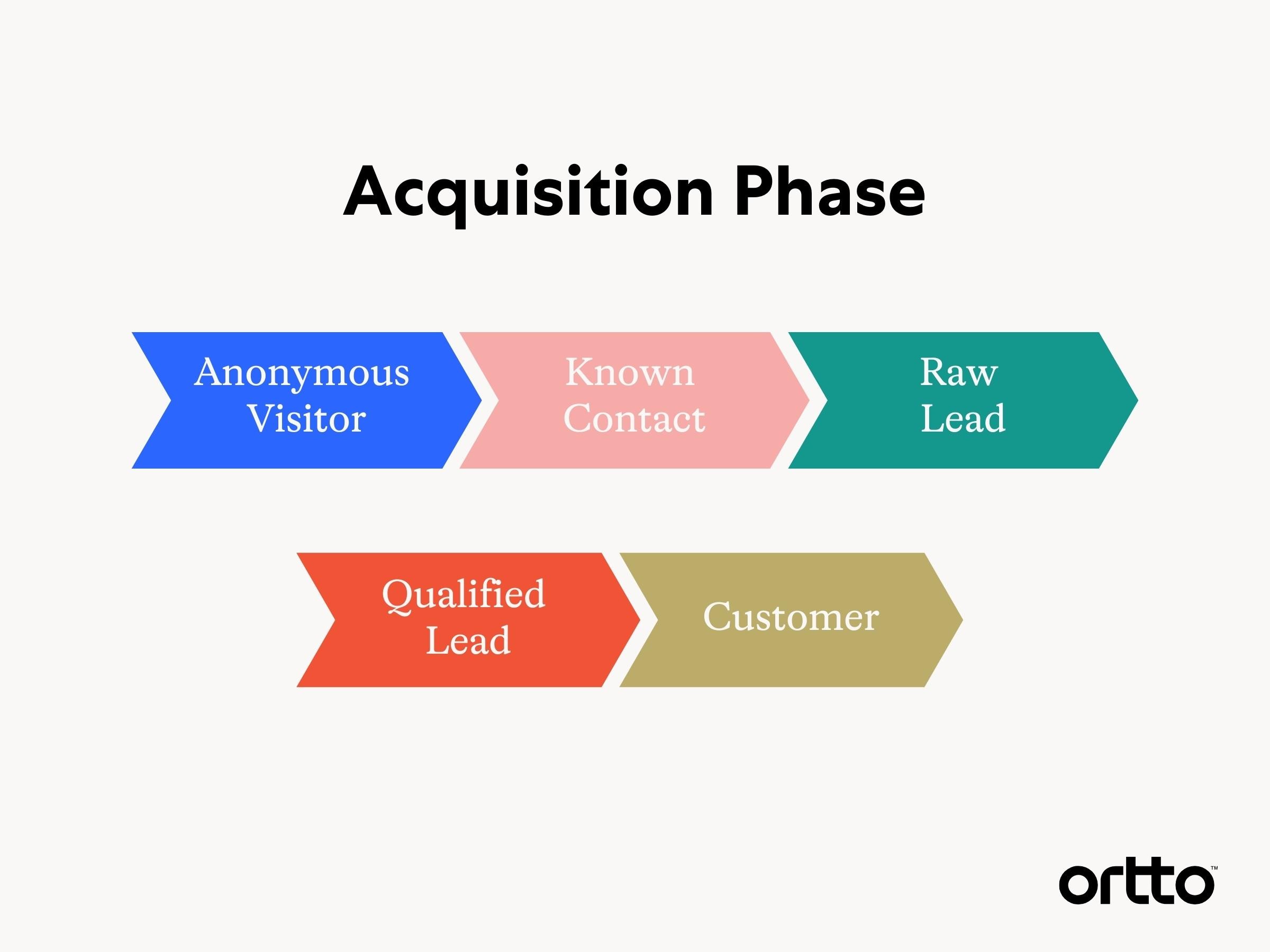
In the acquisition stage, the objective is to convert anonymous website visitors into paying customers. The progression looks like this:
Anonymous visitor > Known contact > Raw lead > Qualified lead > Customer
Acquisition journeys focus on capturing intent, qualifying interest, and moving prospects toward a conversion action. The goal is not just to generate volume, but to identify the leads most likely to convert and route them appropriately.
Stage 2: Nurture
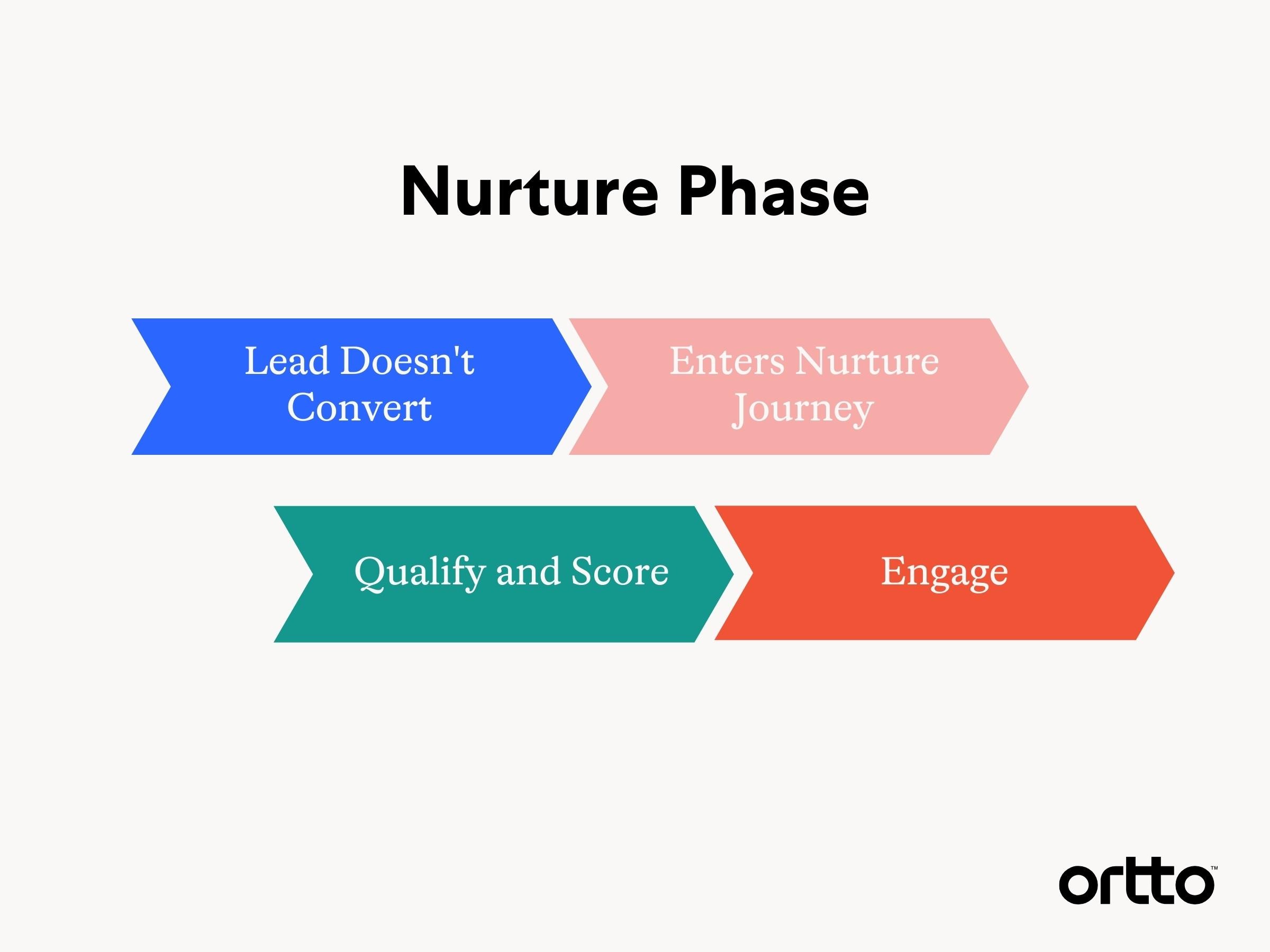
In the nurture stage, the objective is to warm up leads who are not yet ready to buy, educate them on the value of your product, and identify the moment when their engagement signals genuine purchase intent. The progression looks like this:
Lead does not convert > Add to nurture > Qualify and score > Engage with buying signals
Nurture journeys are the connective tissue of the customer lifecycle. They ensure no qualified lead goes cold simply because the timing was not right at first contact.
Stage 3: Growth
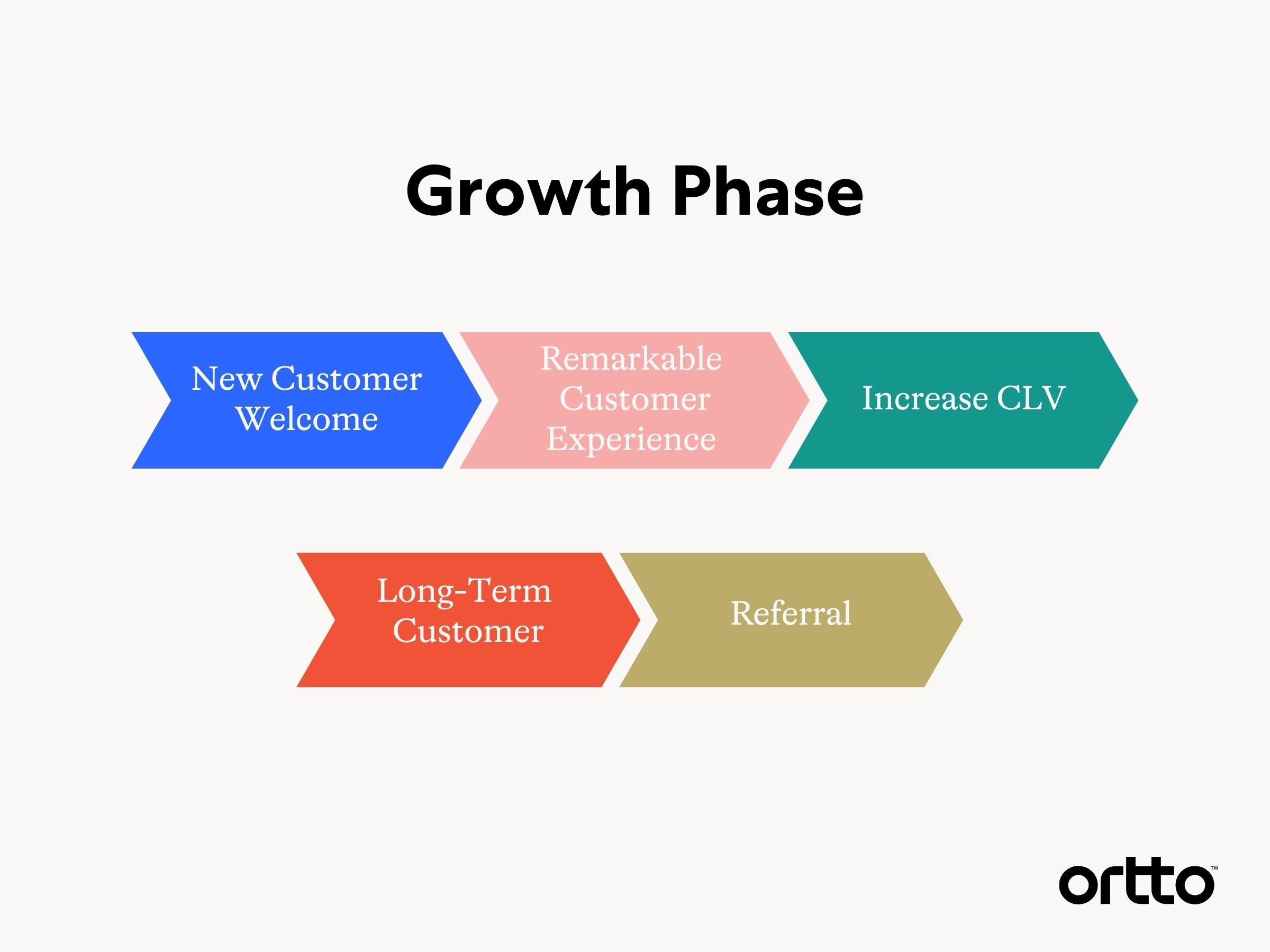
In the growth stage, the objective is to welcome new customers effectively, help them achieve success with your product, and grow their lifetime value through ongoing engagement, expansion offers, and advocacy programs. The progression looks like this:
New customer welcomed > Remarkable experience delivered > CLV increased > Long-term customer > Referral generated
Growth-stage journeys are where the real compounding value of customer journey marketing is realized. They are also the most commonly underdeveloped area of most marketing programs.
Customer journey types: A practical guide
Within each stage, there are specific journey types with distinct goals, triggers, and messaging strategies. Below are the most important journeys to build, organized by lifecycle stage.
Acquisition journeys
Lead capture and awareness
Before you can run a lead nurture journey, you need leads. Effective lead capture journeys use a combination of tactics to convert anonymous visitors into known contacts:
Exit-intent and scroll-triggered popups for email capture
Lead magnets: ebooks, templates, checklists, or tools that exchange value for contact information
Gated content integrated into automated follow-up journeys
Newsletter sign-up flows with a clear value proposition
Webinar and event registration sequences
Ortto's popup, form, and survey tools let you build behavior-triggered capture experiences that feed directly into journey automations, so a new subscriber immediately enters the appropriate welcome or nurture sequence without any manual intervention.
Lead follow-up
When a lead submits a form, downloads a piece of content, or requests a demo, the follow-up journey capitalizes on the moment when your brand is most top of mind. Response time matters significantly: research by Harvard Business Review found that contacting a lead within one hour of their inquiry makes conversion 7x more likely than following up after two hours.
The goal and content of a lead follow-up journey varies by business model and the triggering action. A B2B company following up on a demo request should focus on confirming the booking and providing context that prepares the prospect for the conversation. A B2C company following up on a product inquiry should focus on social proof and removing objections. In both cases, the journey should be triggered immediately and tailored to the specific action that initiated it.
Lead qualification
Qualification journeys follow up on behavioral signals that indicate active interest: pricing page visits, product one-pager downloads, competitor comparison content views, or repeated website visits within a short window. The goal is to move the lead from passive interest to an active conversion action.
Common qualification journey structures include a sequence of increasingly specific content offers, a direct invite to book a demo or start a trial, and a conditional branch based on lead score: high-scoring leads are routed to sales outreach while lower-scoring leads continue in the nurture sequence.
In Ortto, lead scoring integrates directly with journey automation. When a lead crosses a scoring threshold, they can be automatically enrolled in a qualification journey, assigned to a sales rep, or both.
Nurture journeys
Welcome journeys
A welcome journey is the first communication a new contact receives after opting in. Its purpose is to create a strong first impression, establish your brand's tone and value proposition, and set expectations for future communication. It should feel warm and personal, not transactional.
Effective welcome journeys differ by entry point. A newsletter subscriber should receive a welcome that explains what they will receive and how often. A new product sign-up should receive a welcome that confirms their decision and sets them up for a successful first experience. In both cases, the welcome journey should avoid a hard sell and focus on delivering immediate value.
New user onboarding
For SaaS businesses, the new user onboarding journey is one of the highest-leverage automations available. Its purpose is to guide trial or new users to their product 'aha moment': the point at which they experience enough value to commit to the product long-term.
Effective onboarding journeys are triggered by product behavior, not just time. A user who has completed a key setup step should receive a different message than one who signed up three days ago and has not logged in again. Ortto's journey builder connects to product usage data, so onboarding messages can be triggered by specific in-product actions rather than running on a fixed schedule regardless of what users have actually done.
Trial lengths typically range from 7 to 30 days. A well-structured onboarding journey for a 14-day trial might include: a welcome and first-step guide on day 1, a tips message triggered by a specific action on day 2 or 3, a social proof or use case message on day 5, a feature spotlight on day 7, and a conversion nudge with a clear offer in the final 3 days before trial expiry.
Check out Ortto's 'New user welcome journey' journey template.
Lifecycle nurture journeys
Lifecycle nurture journeys are designed for leads who are not yet ready to convert but have demonstrated enough interest to be worth maintaining a relationship with. Their purpose is to keep your brand relevant while the prospect continues their buying journey, providing genuinely useful content that helps them understand their problem, evaluate solutions, and build a business case.
Effective lifecycle nurture content includes: popular blog posts repurposed as emails, ebooks or guides delivered in a digestible format, customer case studies relevant to the prospect's industry or role, product best practices, and industry news and insights. Communications are typically timed 5 to 28 days apart and focus on value delivery rather than conversion pressure. The conversion ask comes at the end of the sequence, when the lead has accumulated enough familiarity and trust to take action.
In Ortto, lifecycle nurture journeys can be personalized based on the prospect's behavior, industry, or lead score, ensuring that a marketing leader receives different content from a product manager, even within the same nurture sequence.
Growth journeys
Customer onboarding and implementation
Once a lead converts to a paying customer, the onboarding journey shifts from product orientation to implementation success. The goal is to help the customer achieve their first concrete outcome with your product as quickly as possible, reducing time-to-value and preventing early-stage churn.
Customer onboarding journeys in Ortto can incorporate email, in-app messages, and SMS, triggered by product usage milestones: setup completion, first data import, first campaign sent, first report viewed. This ensures the onboarding communication stays in sync with what the customer has actually accomplished, rather than delivering setup instructions to someone who completed setup three days ago.
Usage-triggered engagement
Usage-triggered journeys are among the most powerful available to SaaS companies. They monitor product behavior and send a personalized nudge when a specific condition is met: a user who has not logged in for 14 days, a team that has not used a high-value feature, an account approaching a usage limit, or a user who has completed a setup step and is ready for the next one.
These journeys are effective precisely because they are timely and relevant. A message triggered by something the user just did (or stopped doing) is far more likely to drive action than a broadcast communication sent to the entire user base on a fixed schedule.
Upsell and expansion
Expansion journeys identify customers who are ready to upgrade and present the right offer at the right moment. The best triggers are usage-based: a customer approaching their plan limit, a team that has adopted enough of the core product to benefit from advanced features, or an account that has been active for long enough to have developed a clear use case for an adjacent product.
Using Ortto's expansion scoring alongside journey automation, teams can identify high-likelihood expansion candidates automatically and enroll them in a personalized upsell sequence or route them to a customer success manager for a conversation.
Re-engagement and win-back
Re-engagement journeys target customers or leads who have gone quiet: a trial user who signed up but never activated, a customer whose usage has dropped significantly, or a churned customer who may be open to returning. These journeys are often overlooked but can produce significant revenue from an audience that has already shown interest in your product.
Effective re-engagement messages are direct, acknowledge the absence without blame, and lead with a clear reason to return: a new feature, an updated product, a special offer, or simply a check-in. A well-timed win-back sequence can recover a meaningful percentage of churned customers at far lower cost than new customer acquisition.
Check out Ortto's 'SMS win-back series for B2C SaaS' and 'Win-back email for recurring payments' journey templates.
Customer journey retargeting
Ad retargeting is most effective when it is integrated with the customer journey rather than running as a standalone channel. A visitor who just downloaded your pricing guide should see a different retargeting ad than one who signed up for a trial six months ago and went quiet. Retargeting ads that reflect where the customer is in their journey are more relevant, less annoying, and significantly more likely to drive action.
Key stat: Retargeting ads get a 10x higher click-through rate than standard display ads when the ad creative is matched to the viewer's stage in the buying journey. (Wishpond)
Stage-matched creative
As customers move through your marketing funnel, their retargeting experience should evolve with them. An awareness-stage visitor who has browsed your homepage twice should see brand-building content: a customer story, a product overview, or a compelling use case. A consideration-stage visitor who has viewed your pricing page multiple times should see a more direct conversion message: a free trial offer, a demo invite, or a comparison guide.
The practical implementation requires audience segments that reflect journey stage and ad creative sets matched to each segment. This is more work than a single retargeting audience with one creative, but the conversion lift typically justifies it.
Intent-based segmentation
Intent-based segmentation uses behavioral data to classify visitors by their likelihood to convert, rather than treating everyone who visited your website as a single audience. Ortto's Checkmate tracking captures behavioral signals across your website and product, making it possible to build intent-based audiences based on page views, time on site, scroll depth, and specific actions taken. These audiences can be synced directly to your ad platforms for targeted retargeting campaigns.
How to measure customer journey marketing success
Every journey should have a defined goal before it is built. The goal determines the metric you track, the threshold you optimize against, and how you evaluate whether the journey is working. Here are the most important goals and metrics for each journey type:
Welcome journey metrics
Email open rate and click rate: The primary engagement indicators for welcome sequences. A low open rate on your welcome email is a strong signal that your subject line or from-name needs work.
Second-message engagement rate: Measures whether the initial welcome has created enough interest to sustain engagement beyond the first touchpoint.
Discount or offer redemption rate: For ecommerce welcome journeys that include an introductory offer.
New user onboarding metrics
Product-qualifying actions taken: The primary conversion metric for SaaS onboarding. What percentage of trial users complete the key setup step or reach the aha moment?
Trial to paid conversion rate: The ultimate measure of onboarding effectiveness.
Time to first key action: How quickly are new users reaching their first product milestone? Reducing this metric typically improves conversion rates.
Lead nurture metrics
MQLs generated: How many nurtured leads have crossed the marketing-qualified threshold?
Demo or trial requests from nurtured leads: A direct measure of nurture-to-conversion effectiveness.
Engagement score trend: Is the lead's engagement increasing, stabilizing, or declining across the nurture sequence?
Growth and retention metrics
Churn rate: The clearest indicator of whether your post-purchase journeys are working.
Expansion revenue: Revenue generated from existing customers through upsells and cross-sells attributed to journey automations.
NPS trend: Are customers more likely to recommend your product over time? A rising NPS is a leading indicator of advocacy and organic growth.
Referrals generated: How many new leads or customers originated from referrals by existing customers in the cohort?
Ortto tip: Use Ortto's journey analytics to track conversion rates at every step of each journey. When you see a significant drop at a specific step, that is your optimization priority. A/B test the message at that step before changing anything else in the sequence.
How Ortto powers customer journey marketing
Ortto is built specifically for customer journey marketing teams. It combines a CDP, a visual journey builder, omnichannel messaging, and analytics in a single platform so teams can build, automate, and optimize every stage of the customer lifecycle without switching between tools.
Journey builder: A visual canvas for building automated journeys triggered by real customer behavior, with branching logic, timing controls, and A/B testing built in.
Unified CDP: Connects data from your CRM, product, support, billing, and marketing tools into a single customer profile, powering the personalization and behavioral triggers that make journey marketing effective.
Omnichannel messaging: Email, SMS, push notifications, in-app messages, and live chat, all orchestrated from a single journey canvas.
Lead scoring integration: Scoring models connect directly to journey automations, routing leads to the right sequence or sales rep based on their fit and intent score.
Journey analytics: Track entries, exits, conversions, and message-level performance for every journey, with custom dashboard support for the metrics that matter most to your business.
Ortto AI: AI-powered recommendations for subject line optimization, send time prediction, and journey performance improvement, built into the platform.
-> See Ortto's journey builder in action — Book a demo
Frequently asked questions
What is customer journey marketing?
Customer journey marketing is a framework for acquiring, nurturing, and growing customers through automated, personalized experiences triggered by real behavioral data. Rather than broadcasting the same message to all contacts, it delivers the right communication at the right stage of each person's relationship with your brand, at scale, without requiring manual effort for each customer.
What are the stages of customer journey marketing?
Customer journey marketing operates across three main stages. Acquisition covers the journey from anonymous visitor to paying customer. Nurture covers the period between initial contact and purchase readiness, using content and engagement to qualify and convert leads who are not yet ready to buy. Growth covers everything after the initial purchase: onboarding, retention, expansion, and advocacy.
What types of journeys should every business build first?
The highest-priority journeys for most businesses are: a welcome journey (for new subscribers or sign-ups), a new user onboarding journey (for trial or new product users), a lead follow-up journey (triggered by high-intent actions like demo requests or pricing page visits), a lifecycle nurture sequence (for leads not yet ready to convert), and a re-engagement journey (for inactive leads or at-risk customers). These five journeys address the most common points of drop-off in the customer lifecycle.
What data do I need to run customer journey marketing?
Effective customer journey marketing requires unified customer data: a single profile for each contact that combines marketing engagement history, product usage data, CRM information, and support history. A customer data platform (CDP) like Ortto brings this data together from multiple sources, making it possible to trigger personalized journeys based on the full context of each customer's behavior rather than just one channel's data.
How is customer journey marketing different from email marketing?
Email marketing is a channel. Customer journey marketing is a strategy that uses multiple channels, including email, SMS, in-app messages, push notifications, and ads, to deliver a coherent, personalized experience across the customer lifecycle. Customer journey marketing is also behavior-triggered rather than broadcast: messages go out when a customer takes a specific action, rather than being sent to everyone on a list at the same time.
How do I measure whether a customer journey is working?
Each journey should have a defined goal set before it launches. For onboarding journeys, track product-qualifying actions and trial-to-paid conversion rate. For nurture journeys, track MQLs generated and demo or trial request rate. For retention journeys, track churn rate and NPS. For expansion journeys, track upsell conversion rate and expansion revenue. In Ortto, journey analytics show performance at the overall journey level and at each individual message step, making it easy to identify where to optimize.
What is a behavior-triggered journey?
A behavior-triggered journey is an automated communication sequence that starts when a customer or lead takes a specific action, rather than being sent on a fixed schedule. Examples include: an onboarding sequence triggered when a new user completes their first login, a re-engagement message triggered when a customer has not logged in for 14 days, or a qualification journey triggered when a lead visits the pricing page for the third time in a week. Behavior-triggered journeys are more relevant and timely than time-based sequences, which is why they consistently produce higher engagement and conversion rates.
How does Ortto support customer journey marketing?
Ortto provides the full stack for customer journey marketing: a CDP that unifies customer data from every source, a visual journey builder that automates behavior-triggered sequences across email, SMS, in-app, and push channels, lead scoring that routes contacts to the right journey automatically, and journey analytics that track performance at every step. Ortto AI adds subject line optimization, send time prediction, and performance recommendations across active journeys.
Final word
Customer journey marketing is not a single campaign or a set-and-forget automation. It is an ongoing practice of designing, measuring, and improving the experience customers have with your brand at every stage of their lifecycle.
The businesses that do it best start simple: a welcome journey, an onboarding sequence, a lead nurture flow. They measure what works, optimize based on data, and expand their journey library over time. The compounding effect is significant. Each journey improvement benefits every subsequent customer who moves through it.
Ortto is built to make this practice accessible for marketing teams of any size, with templates to get started quickly, a visual builder that does not require engineering support, and analytics that make optimization fast and data-driven.
-> Book a demo to see how Ortto powers customer journey marketing
Author

More by Sidney O'Connell



Sidney O'Connell has no more articles